At a glance
An ADU, short for accessory dwelling unit, is a small second home on the same lot as a house. It has its own kitchen, bathroom and place to sleep, so someone can live there full time. People also call it a granny flat, an in-law unit, a backyard cottage or a casita. Those are nicknames. "ADU" is the legal term your city uses, and the legal definition is what decides whether you can build one.
The plain-English definition
California's law is the most detailed in the country, and most other states use similar wording. The state handbook defines an ADU as a unit that provides complete, independent living facilities for one or more persons, on a lot with an existing or proposed main home. It must include permanent provisions for living, sleeping, eating, cooking and sanitation.
In other words, three things make a space an ADU:
- It is on the same lot as a main house.
- It has its own kitchen and bathroom.
- It is built to be lived in, not just used.
A room with a bed and no kitchen is not an ADU. Neither is a shed, a pool house with a half bath, or an RV parked in the driveway.
The four kinds of ADU
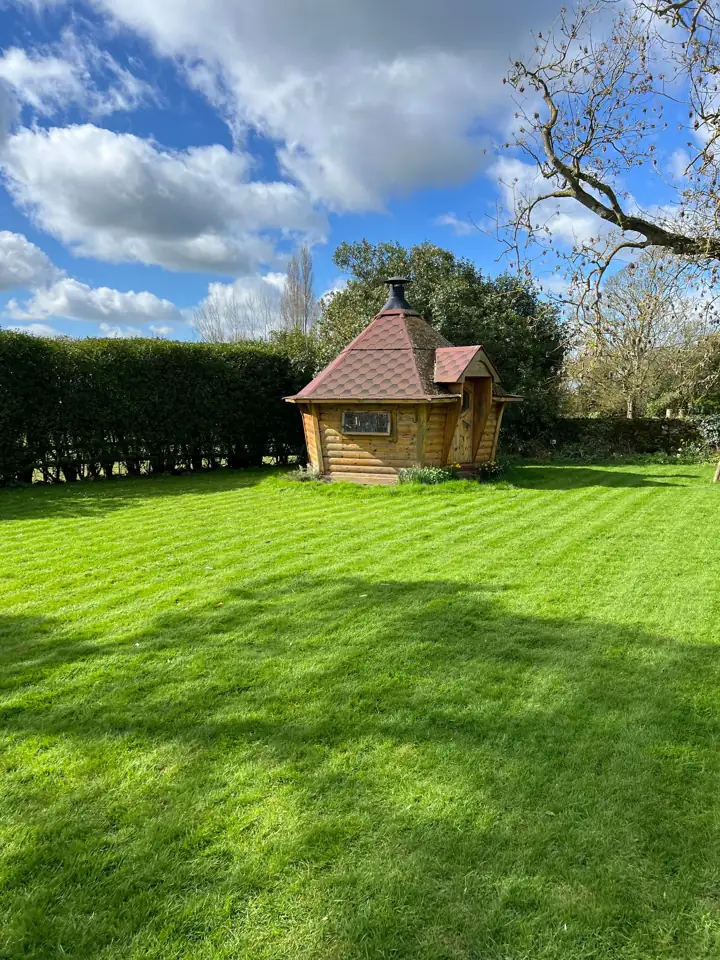
- Detached: a separate small house in the backyard. This is what most people picture.
- Attached: an addition that shares a wall with the main house. In California an attached ADU cannot exceed 50 percent of the main home's floor area.
- Conversion: an existing garage, basement or attic turned into a unit.
- JADU (junior ADU): a unit of no more than 500 square feet carved out of the inside of a single-family home. It can share a bathroom with the house. See the JADU vs detached guide.
ADU vs guest house vs casita
A guest house usually means a separate building for visitors. If it has a full kitchen and is permitted as a dwelling, it is an ADU. If it has no kitchen, most cities treat it as an accessory structure, which California defines as a building accessory and incidental to a dwelling. That matters: an accessory structure usually cannot be rented as a home, and it may get none of the state protections ADUs get.
"Casita" is a regional word, common in the Southwest, for the same thing. The label does not matter to the city. The kitchen, the bathroom and the permit do.
ADU vs tiny home
"Tiny home" is a marketing term, not a legal one. California's housing agency says state ADU law does not specifically reference tiny homes: if a tiny home meets the ADU definition, it is subject to ADU law. A tiny home on wheels is often treated as a vehicle instead, and the state has a separate bulletin explaining the differences. Ask your city before you buy one.
ADU vs manufactured home
A manufactured home can be an ADU. California's definition expressly includes a manufactured home built to the federal HUD code. So does a small efficiency unit of at least 190 square feet with its own kitchen and bathroom. Prefab and modular units built to the state building code also qualify once they are permitted and set on a foundation.
Why the label matters
Calling a space an ADU is not just paperwork. In states with strong ADU laws, the label unlocks rights:
- Washington requires cities in urban growth areas to allow two ADUs per lot and at least 1,000 square feet.
- Oregon requires larger cities to allow at least one ADU per detached single-family home.
- Fannie Mae lets a lender count an ADU on a one-unit property, which can affect your loan and appraisal.
Freddie Mac researchers note that ADUs are often hard to spot in listing data because sellers use so many different names. That is one more reason to permit the unit as an ADU and call it that.
What to do next
- Check what your city allows on our city rules pages.
- Compare the kinds of units in our quick quiz, Which ADU fits.
- Price it with the free estimator before you call anyone.
- When you are ready, BackyardStack can connect you with builders in our directory who serve your area.
Before you call a builder: answer six questions to pick a type, rough out a budget, and save builders to My Stack as you go.
Sources
- California Department of Housing and Community Development, Accessory Dwelling Unit Handbook (updated March 2026)
- California HCD, Information Bulletin 2016-01: Tiny Homes
- Washington State Department of Commerce, ADU guidance for HB 1337 (June 2024)
- Oregon Revised Statutes 197A.425, Accessory dwelling units
- Fannie Mae, Accessory Dwelling Units (ADUs)
- Freddie Mac, Identifying Accessory Dwelling Units from Real Estate Listing Data (2020)